

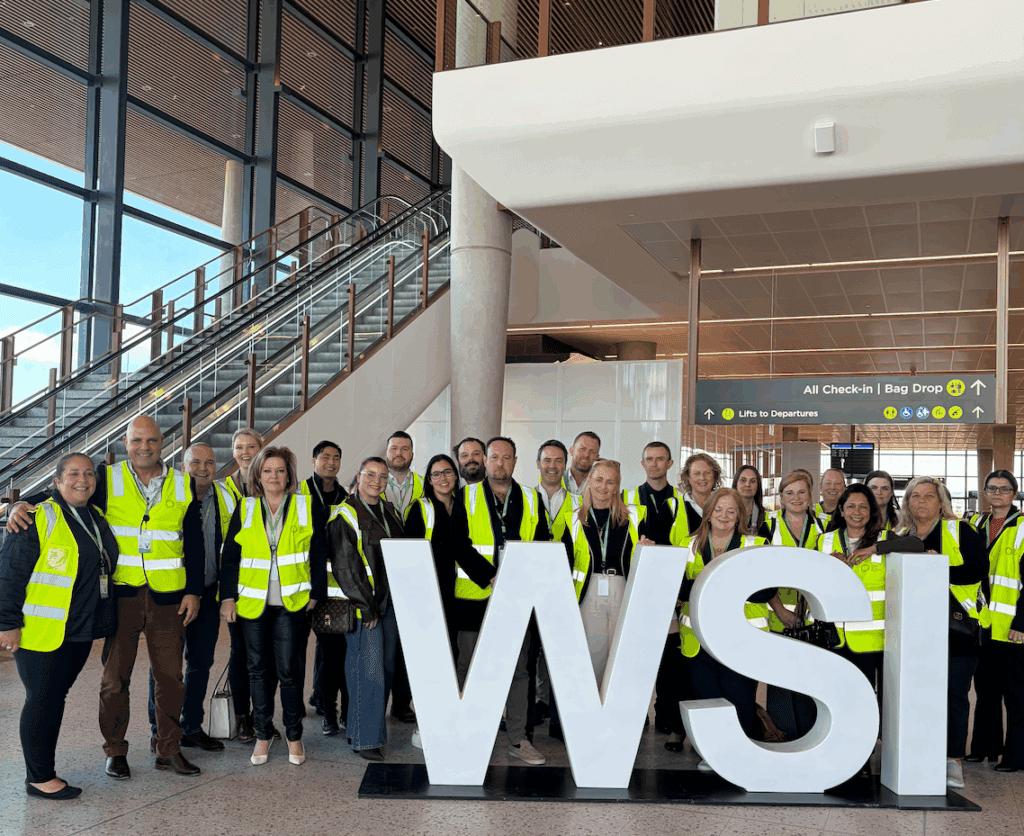
When some of Australia’s most respected travel advisors were given an exclusive behind-the-scenes look at Western Sydney International (WSI) airport last week, the response was overwhelming.
The travel experts left with a clear sense of the commercial and customer opportunities WSI presents and the firsthand confidence to put it in front of their clients from day one.
Approximately 25 members from 13 businesses within CT Partners, the country’s leading independently owned travel buying network, representing $2.5 billion in annual travel spend and 1.3 million travellers, were taken on the most extensive trade familiarization tour of the terminal and its infrastructure to date, hosted by Singapore Airlines.
The influential group got the full terminal experience including check-in technology, baggage automation, aerobridge, landside and airside areas and on to the tarmac itself.
The visit, the first in a series of exclusive access events facilitated by Singapore Airlines, comes just four months out from the new airport’s October opening.
WSI isn’t just good news for Western Sydney. It offers a genuine shift in how travellers right across Greater Sydney, and as far as the Central Coast, will think about getting on a plane.
And for the thousands of domestic and international travellers who transit through Sydney each day, it will unlock connections and departure times that have never been on offer before.
WSI has been designed as a smart airport from the ground up. Technology is integrated at every touchpoint including streamlining check-in, baggage handling and passenger flow to create an experience that is genuinely faster and simpler than what travellers are used to.
Then there is the curfew. Or rather, the absence of one.
WSI will run 24 hours a day, seven days a week.
That alone makes it a compelling airport of choice for carriers who want operational flexibility and for travellers who want to fly on their terms.
It also unlocks departure times and international connections, including significantly improved routing to Europe, that have simply never been available from Sydney before.
The physical scale tells its own story. At 1,780 hectares, with a 3.7-kilometre runway capable of handling aircraft up to the A380, WSI has been built for growth.
Initial capacity of 10 million passengers annually will eventually scale to 82 million, making it Australia’s largest airport.
Three additional passenger terminals and a business precinct are planned beyond the current build.
Singapore Airlines, the first international airline to commit to operating from WSI, will commence daily flights between Singapore Changi Airport and Western Sydney Airport using Airbus A350-900 medium-haul aircraft offering both business class and economy class.
The inaugural service commences on November 23. The late-night departure, made possible by WSI’s curfew-free operations, connects directly into Singapore Changi Airport’s morning bank of international connections.
“Western Sydney International Airport changes everything for this region and for Sydney as a whole,’’ says Matt Masson, CEO, CT Partners.
“An international airport of this scale and ambition repositions Western Sydney as a destination in its own right, for business, for tourism, for the communities that call it home.
“But its appeal goes well beyond the local catchment. The curfew-free operations give travellers right across Sydney and the Central Coast a genuine alternative with more flexibility, better connections, and a travel experience built around the passenger.
“Our members left this visit knowing exactly how to communicate that to their clients, and the opportunity is enormous.”
Rosanna Piaggio, manager agency sales, Singapore Airlines, said her company was proud to be the first international carrier to commit to Western Sydney International Airport.
“This is a milestone moment for Australian aviation, and we’re excited about what it means: more flexibility with curfew-free departures, and a new gateway into Greater Sydney and beyond.’’