

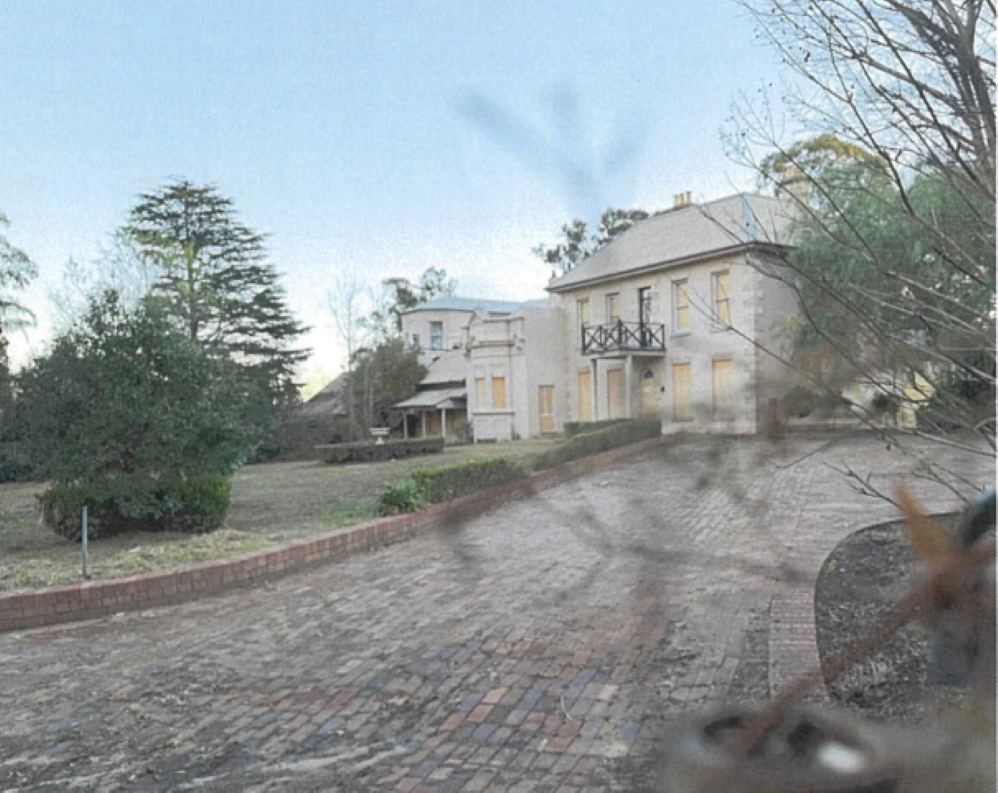
Nathan Hagarty has welcomed a commitment from Campbelltown Council to work with the owners of historic property Eschol Park House to protect its heritage.
The Member for Leppington wrote to Campbelltown Council in the wake of community outrage over the dilapidated state of the building and the outdoor garden areas.
He has now heard back from Council, who say the state of the property has now been improved.
“Recent inspections have confirmed that the building is secure against unauthorised access,’’ said the council letter signed by CEO Lindy Deitz.
“The site is protected by locked gates and security cameras, while timber boarding has been installed over all windows and doors to help prevent damage and vandalism.
“The property is also no longer overgrown with vegetation, as in the attached recent image (above).
“Development consent was granted late 2025 for the adaptive reuse of the heritage building as part of a 124-place childcare centre development.
“Council continues to work with the property owners to obtain further information regarding the anticipated commencement of the development and to ensure that the approved conservation works are undertaken as part of the project,’’ Ms Deitz said in the letter.
Mr Hagarty said Council’s response was a positive step.
“It’s reassuring that the site has been secured, overgrown vegetation cleared, and that Council is continuing to work with the property owner on conservation works,’’ he said.
“But the real milestone will be seeing conservation works commence.
“Eschol Park House is an important part of our local heritage and I know many people in our community want to see this historic building restored and given a new lease on life.
“I’ll continue working with Council and monitoring progress to help ensure this significant heritage site is preserved for future generations and restored in line with the approved plans,’’ he said.
Eschol Park House is of historical significance as one of the early Colonial land grants (1816) in the Campbelltown area, with documentary evidence of buildings from a title document dated 18 March 1817.
The site has been occupied continuously by European settlers since 1817 and subject to phases of development by its owners throughout the 19th and 20th centuries.
Historic records state that “The site is evocative of a homestead associated with agricultural activities throughout this period including: land clearing and the development of colonial estates for wheat growing and cattle grazing, utilising convict labour; the development of a country villa, the breeding of thoroughbred horses; the establishment and operation of an internationally recognised 19th century vineyard (Eschol Park Wines); the alteration of land use to dairying in the early 20th century.’’

Good news! Thanks Eric.
The demise of Eschol Park House started the day that Campbelltown City Council allowed private housing to go right up to the edge of the property decades ago, much to the disappointment of local historians. It has been a slow decline ever since and shows only too well how the Council talks the talk, saving old buildings etc., but doesn’t do much in reality. It’s too late to do anything about the landscape of the area – houses hiding much of the glory of that old building, where once it stood high on the hill, overlooking the city of Campbelltown and making a statement in just being there, a nod to seeking out other historic houses in and around the town. Campbelltown is slowly going down the gurgler in the rush for modern structures that leave nothing much to appreciate in the history of the town. It’s very sad.
The same happened with Blair Athol.