

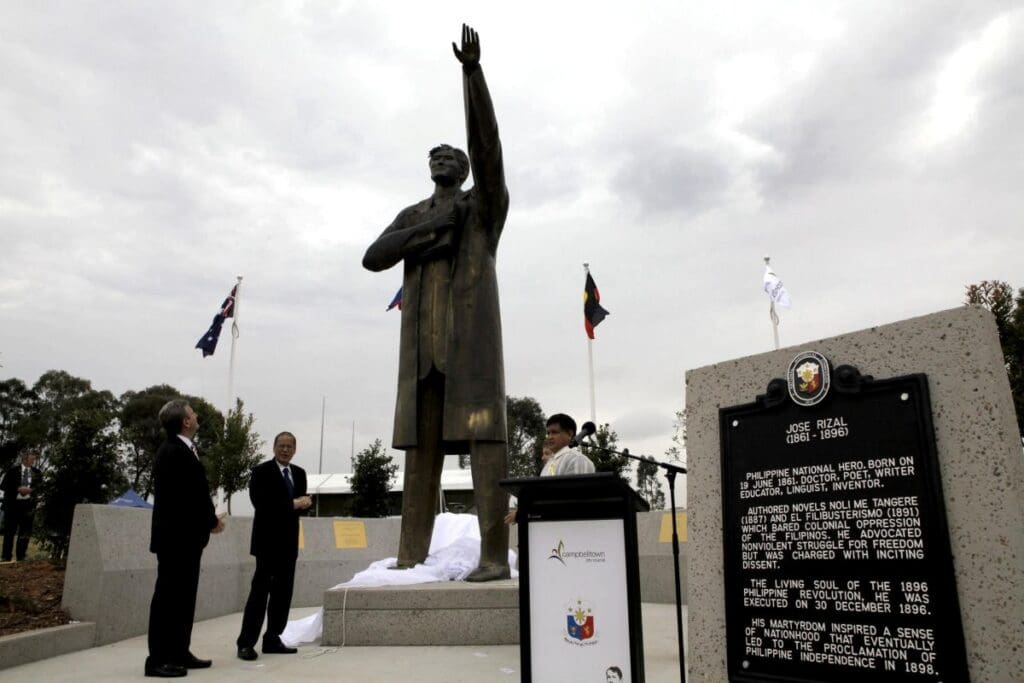
Monuments have been in the news for Campbelltown in the past few days. We’ll come back to the International Mother Language Day monument later, but people forget there is already another monument in Campbelltown.
Located in a quiet park in Rosemeadow, the bronze statue of Filipino legend Jose Rizal stands more than five metres high, obviously dominating the immediate landscape around it.
Rizal led the peaceful crusade against Spanish colonialism in the Philippines, and is considered to be the greatest hero of the Filipino people.
His huge statue in Rizal Park at Rosemeadow was unveiled in 2012 by then NSW premier Barry O’Farrell, and Filipino president Noynoy Aquino (pictured above).
At the time it was estimated that more than 5,000 Campbelltown residents identified as having Filipino heritage.
A Filipino resident, Rey Manoto, was later elected to Campbelltown Council under the banner of the Labor Party, eventually retiring for health reasons.
Let’s now fast forward to the present times, when Campbelltown Council has offered to add $50,000 of ratepayers’ money to $50,000 made available by federal MP Dr Mike Freelander for a Mother Language Day monument somewhere in Campbelltown.
As some of our readers have pointed out, the council’s $50,000 – more or less for landscaping around the monument – raises questions about the role of councils and where and how they spend the money they receive, mainly through rates.
Rates, roads and rubbish, thundered one of our readers, is what councils should stick to.
We do live in a more complicated world, sure, but it’s interesting that the Filipino community of Campbelltown did not go cap in hand asking for ratepayers’ dollars to erect the bronze statue of Rizal just 14 years ago.
For starters, they got the statue made for free by a world-renowned Filipino sculptor and artist, Eduardo Castrillo.
The rest of the cost was met by fundraising by the Filipino community for many years.
So that’s one argument, that if a community group wants to honour someone or something, sure, but pay for it yourself.
Perhaps the time has come for local government to have a long, hard look at this issue before the trickle of requests for this type of funding becomes a torrent as more and more community groups put their hand out for ratepayers’ dollars.
And if councils decide they want to expand their range from rates, roads and rubbish, well then, they should get more grant money from the state and federal governments.
The council would be better off spending the money mowing the areas they OWN like parks and green space.
Mother Language Day, please.
Is the statue going to be a large mouth? There is rubbish all over the town on footpaths and dumping sites.
This council needs to get real and remember that ratepayers vote them in.
What a joke!
The real conundrum here is how do you turn International Mother Language Day into a monument?
But where does it end? Should we have a monument for Red Nose Day? Bring Your Dog To Work Day? Prosecco Day? Actually I love Prosecco.
Why don’t we have a monument to Fred Fisher, since we have a festival for him, but no one knows what he looks like?
There must be other eminent Campbelltonians who deserve memorialising.
You know, actual people.