

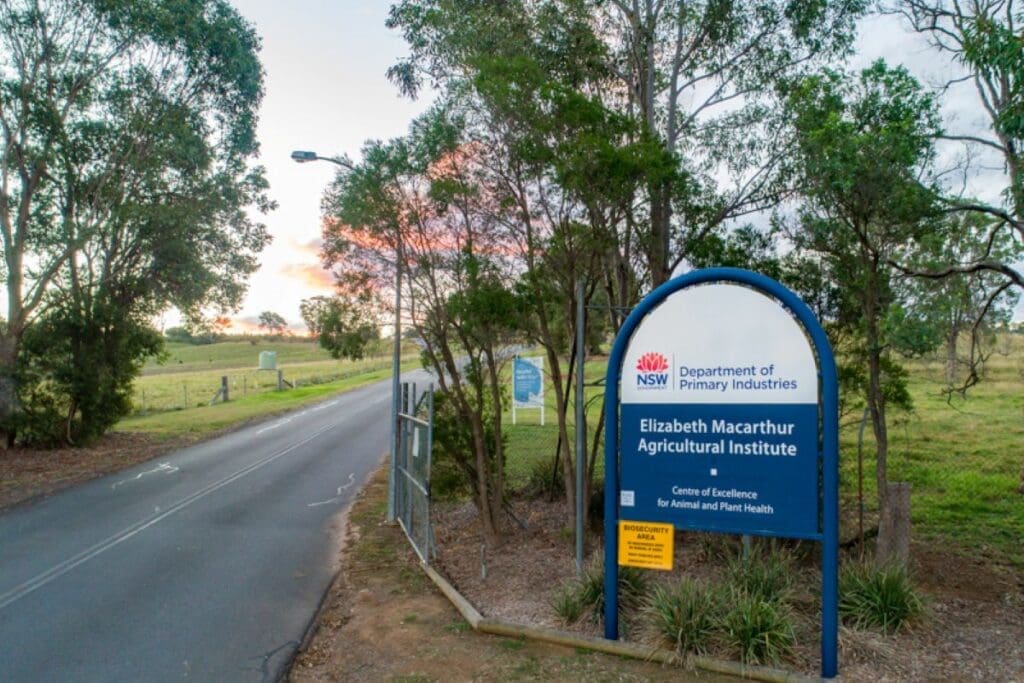
Construction has started on $31 million infrastructure upgrades at the historic Elizabeth Macarthur Agricultural Institute at Camden Park.
The work is part of the Minns Labor Government’s commitment to protecting the state’s agriculture sector, supporting research and innovation and strengthening our biosecurity capabilities.
The world class facility in Macarthur plays a critical role with a team of renowned scientists working to find new ways to reduce threats to agriculture, the environment, and our community.
Opened in 1990, EMAI’s 1,600 hectares is part of the original land granted to agricultural pioneers John and Elizabeth Macarthur in 1805.
It includes the original Cowpastures where the cattle that escaped from the First Fleet settled.
EMAI continues the Australian tradition of the innovative agricultural developments started by John and Elizabeth Macarthur almost 200 years ago.
Breeding methods developed by the Macarthurs contributed to the development of the Merino sheep as we know it today.
Descendants of the Macarthurs’ original Spanish Merino flock graze the paddocks at Belgenny and elsewhere on EMAI.
Belgenny Farm, also located on the EMAI site, considered the birthplace of Australian agriculture, is open to the public and available for social and educational functions.
The latest upgrades at EMAI include:
- a $15 million high-containment insectary that will strengthen NSW’s capacity to protect agriculture and the environment from damaging insect and mite pests.
The facility will enable rapid, secure research to respond to exotic incursions, and improve biosecurity preparedness for industries such as grains, horticulture, livestock, forestry and cotton, as well as the environment, by increasing the likelihood of a successful response.
This facility was funded by the NSW Government with a $2 million contribution from the Grains Research and Development Corporation (GRDC).
- $6.5 million to renovate the existing greenhouse complex to support plant biosecurity research and diagnostics. This includes the host diversity of new and emerging pathogens, developing new surveillance methods, and improved control options.
Plant industries depend on pathogen-tested propagation stock, so upgraded greenhouse facilities will strengthen early detection of exotic and emerging pathogens.
- $4.8 million to extend the animal house facility to support priority biosecurity research.
- $4.7 million to other critical laboratory and infrastructure upgrades across the EMAI campus.
The greenhouse research complex, animal house research facility extension and critical laboratory and infrastructure upgrades are funded under the government’s $60 million critical infrastructure uplift program.
“The Elizabeth Macarthur Agricultural Institute is one of the world’s leading primary industries research centres and the Minns Government is committed to making it even better,’’ says agriculture minister Tara Moriarty.
“The work undertaken by the dedicated scientists has aided biosecurity response capacity for red imported fire ant, Xylella, khapra beetle, Japanese encephalitis virus and white spot syndrome virus, protecting the State’s multibillion dollar primary industries sector.
“The Minns Government recognises how crucial biosecurity research is with this $31 million investment in labs, greenhouses, and research facilities at the Elizabeth Macarthur Agricultural Institute.’’