

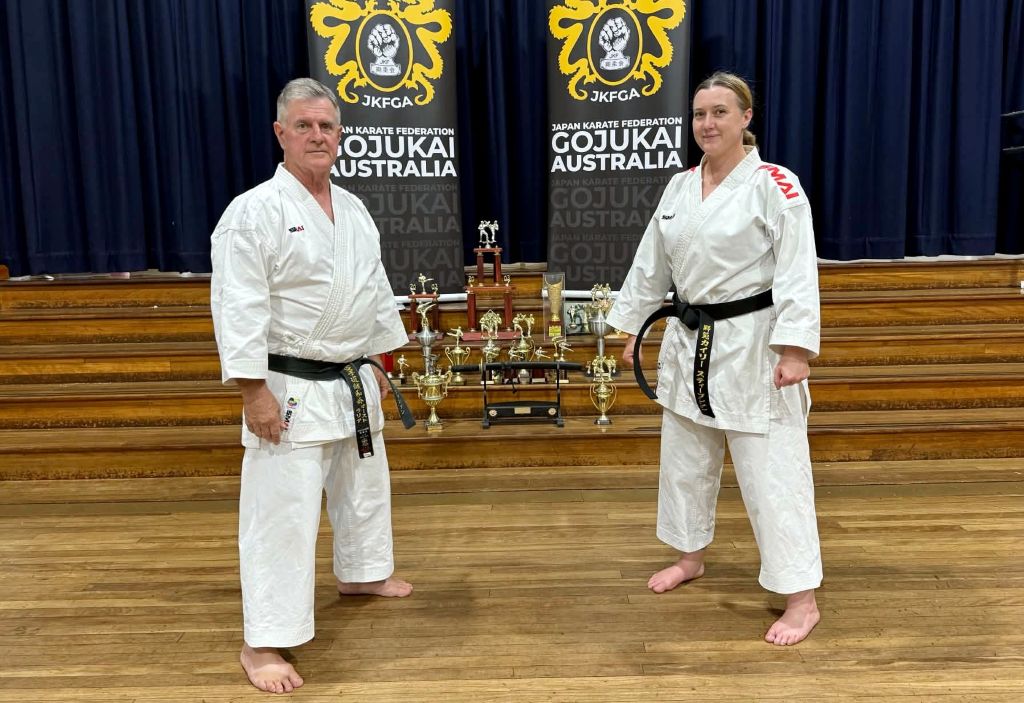
Macarthur karate teacher Glenn Stephenson has just returned from Japan where he earned his 8th Dan.
His daughter Kylie meanwhile is proof that the apple doesn’t fall far from the tree – she now has her 5th Dan.
Kylie lives in Thirlmere now, but grew up in Rosemeadow, where Glenn still calls home.
Before we talk about this wonderful father-daughter martial arts combination, let’s clear up what is a Dan.
Kylie explains that it’s a grade beyond black belt, and each Dan represents another level of development in karate.
“I think people often see a black belt as the ultimate goal, but really, it is the beginning of a much longer journey,’’ she says.
“An analogy I like is education. You could think of achieving your black belt as finishing primary school, reaching 5th Dan as completing high school, and 8th Dan as working towards a PhD. Obviously, karate isn’t an academic qualification, but it gives you an idea of the years of learning, experience and understanding involved. The higher you go, the more you realise there is still to learn.’’
Kylie says the pair have two grading pathways.
“Seiwakai, which is our own karate organisation, and JKF Gojukai, which is part of a broader Japanese karate organisation.’’
Kylie achieved her 5th Dan in both last year, but she has a way to go to catch up with her father, who has become the first Australian in Seiwakai to achieve 8th Dan in 2026, although he still needs to meet the separate requirements and timing for his 8th Dan in JKF Gojukai.
Anyone who’s seen a friend or a family member undergo a black belt assessment know what a gruelling test it is.
For Kylie’s 5th Dan, the grading process in Japan was particularly demanding. It began with six intensive days of training in Omagari before her Seiwakai grading, followed by an additional day in Sendai before her JKF Gojukai grading.
“You’re being watched and assessed throughout the process, not just on the day of the grading itself,’’ says Kylie.
“The standard is incredibly high, and the experience is much more intense than people might imagine. By the time you reach that level, it’s not just about demonstrating techniques; it’s about showing the depth of your knowledge, your consistency and your understanding of karate.’’
Kylie says she has also competed in karate for many years and won state and national titles, but accepts it’s a different test from the one you undergo to get a black belt or higher.
“In tournaments, you are competing against other athletes. Grading is about your own development, your technical ability, your understanding of karate and whether you are ready for the next level,’’ she says.
“That’s one of the things I value about karate. You can compete against someone on the tournament floor, but when it comes to grading, their success doesn’t take anything away from yours. We’re all working towards our own goals, and there’s room to recognise and respect each other’s achievements.
Glenn first became interested in karate in 1979, when a friend invited him to visit a karate school in Ashfield.
“I trained three days a week under Keith Hill Shihan, my first instructor. The training was demanding, but I loved it.’’
Three years later Glenn achieved his first black belt, or Dan.
Karate eventually became much more than a hobby and when he and his wife Lesley moved to Campbelltown he was encouraged to start teaching, even though Glenn was still a brown belt.
“I took that opportunity, and it became the beginning of a lifelong commitment to teaching and helping others develop,’’ he says now, just days after returning from Japan with Dan number eight.
“Looking back, achieving my first Dan was just one milestone in a journey that has now spanned more than four decades,’’ he says.
Naturally, he was Kylie’s teacher when she started karate at the tender age of four or five, depending on whether you believe the father or the daughter.
“It took me until I was 16 to achieve my black belt,’’ she says
“I was training three to six days a week, but being the Shihan’s daughter didn’t necessarily mean I had an easier path. If anything, Dad was often more cautious about allowing me to progress through the grades.
“At times, it was frustrating watching other students who had started after me move ahead.
“But looking back, it taught me something important: grading isn’t a race. Your belt should reflect your ability, knowledge and readiness, rather than simply how quickly you can move up the ranks. Everyone has their own journey, and when someone achieves a grade they’ve worked hard for, it’s something to respect and celebrate.
“Dad has been a huge influence on my karate journey. Having him as my instructor has given me opportunities to learn from some incredible people, including senior instructors in Japan. But it has also meant being held to a high standard.’’
Kylie has had her own journey as a competitor, winning state and national titles, and now also teaching karate.
“Having Dad as both my instructor and my father means karate has always been a big part of our relationship,’’ she adds.
Kylie obviously looks up to her father, and probably happy to know he has no plans to retire after a 40 year relationship with karate.
“I’ve spent my whole life watching him train, teach and travel for karate, so I honestly can’t imagine him stopping,’’ says Kylie.
“What makes me proudest isn’t just the 8th Dan itself. It’s everything behind it: the decades of training, the people he has taught, and the time he has given to help others achieve their own goals.
“For me personally, my focus now is on continuing to train, developing my skills and preparing for my next grading when the time comes. I don’t want to stop learning just because I’ve reached 5th Dan. There is always something to improve.
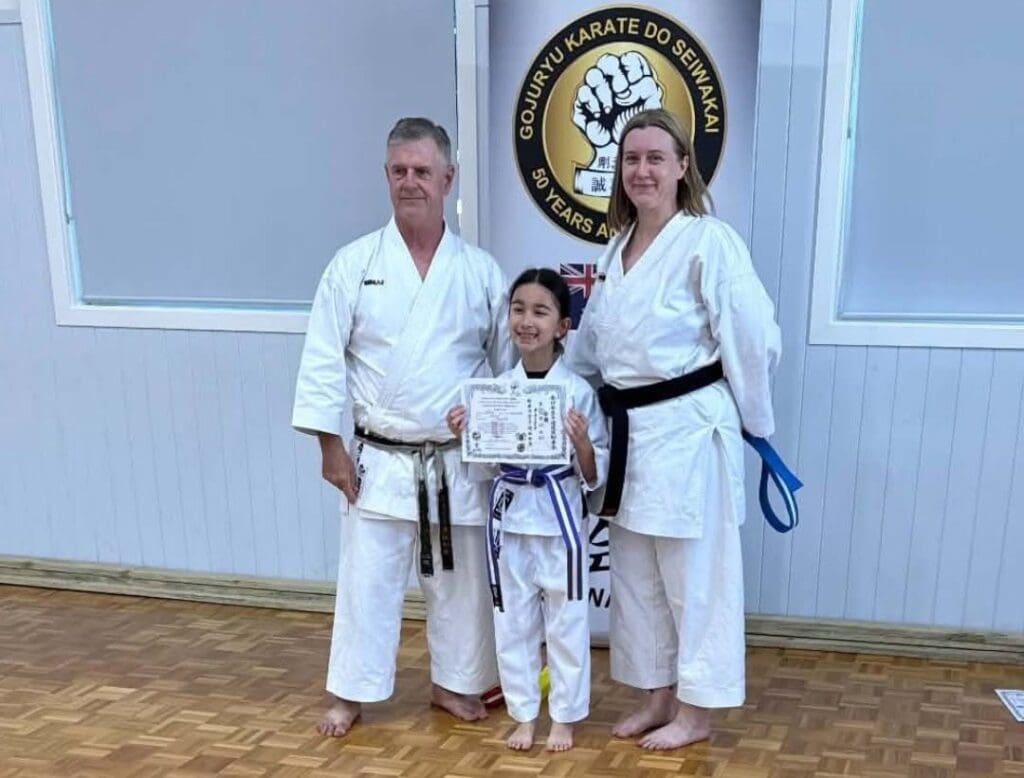
“I’m also teaching at Karate Academy Picton (pictured above), which I thoroughly enjoy. Teaching is my way of giving back to a sport that has given me so much throughout my life.’’