

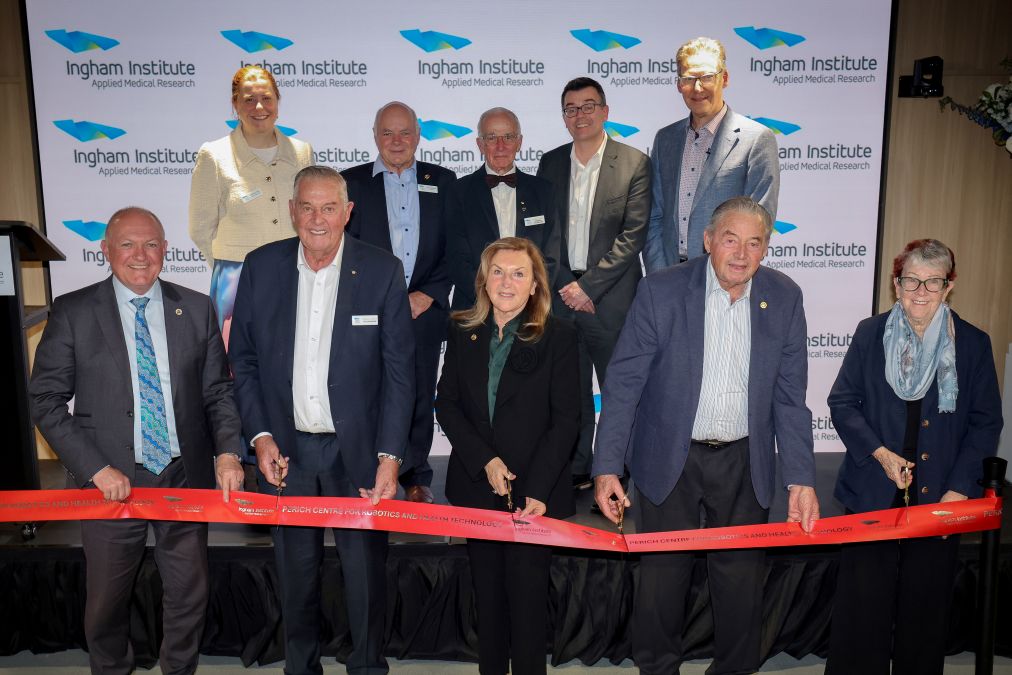
A powerful new chapter in healthcare innovation is here, as Ingham Institute for Applied Medical Research officially launches the Perich Centre, which is dedicated to advancing health equity through health technology.
The Perich Centre for Robotics and Health Technology is a flagship multidisciplinary hub; home to Ingham Institute’s clinical research, teaching and advanced training in healthcare automation.
This is health technology with the power to transform care and save lives, ensuring it helps the right people in the right way at the right time.
Lauded as an “automation imaginarium,” the centre was officially opened this week at a ribbon-cutting ceremony at Ingham Institute in Liverpool, attended by members of the Perich family Ron and Lyn Perich and Tony and Cathy Perich, the NSW minister for medical research David Harris (pictured below) and the centre’s clinical lead, Dr Glen Schlaphoff.
“With its focus on collaboration at the cutting edge of healthcare, the Perich Centre will strengthen Ingham Institute’s position as a national and global leader in digital and robotic healthcare,’’ Mr Harris said.
“This new centre will enable researchers to pioneer new technologies to help ensure no matter where people live – including those in disadvantaged and regional, rural and remote communities – they can have the best possible care.”
Dr Schlaphoff pointed out that without ethical engagement, community design and strong clinical leadership, healthcare technologies can widen health gaps, rather than reducing them.
“At Ingham Institute, ‘tech-quity’ drives everything we do – from early-stage innovation to large-scale adoption – so that automation, robotics and digital tools are built and implemented with equity in mind,” he said.
The Perich Centre is home to more than 60 clinician scientists across nursing, midwifery, allied health and medical specialties who are innovating, assessing and accelerating technology to improve lives – starting in South West Sydney.
The result of tireless advocacy and passion for healthcare automation, the centre’s vision has been led by the Perich family, Ingham Institute board of directors, and Institute director Professor Les Bokey.
“South Western Sydney is one of Australia’s most diverse communities, and it faces some of the country’s toughest health challenges,” Mark Perich said at the official opening.
“If we develop solutions that work here – that are inclusive, ethical, and evidence-based – we can make a difference globally.”
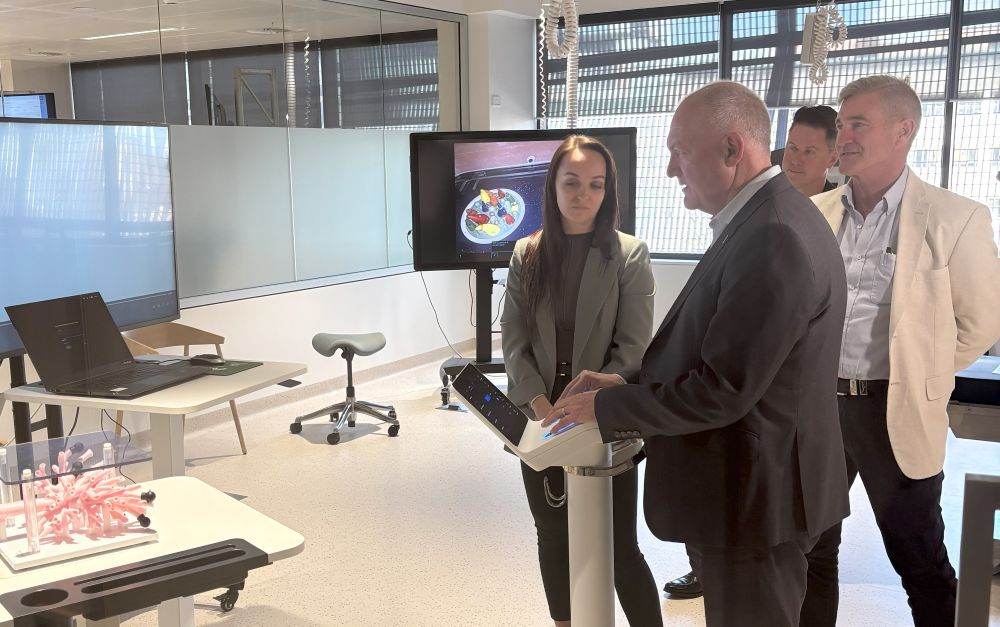
The Ingham Institute translates community-focused research into community-focused health benefits and the Perich Centre will advance this mission with a focus on:
- Assessing remote diagnostics and intervention, so people can access critical care no matter where they live.
- Smarter hospital systems, freeing up time for frontline staff to focus on patients.
- Rehabilitation robotics and assistive technology.
- Automation of everything from patient access and care to hospital logistics and service delivery and advanced training and education, to prepare the next generation of healthcare workers.
Prof Les Bokey said he was delighted to hand leadership of this important work – and advancement of his vision – to the centre’s clinical lead and ambassador, Dr Glen Schlaphoff.
“The considered and correct adoption of automation in health is not just a moral imperative,” Prof Bokey said.
“It’s how we create sustainable health systems, improve outcomes across diverse populations, and unlock the full potential of technology for global health impact.”
The Perich Centre will be home to projects including:
- Remote sensing and wearable devices in midwifery, nursing and women’s health.
- Allied health led rehabilitation robotics and gamified therapy for acquired brain injury.
- Diverse application of digital solutions for diabetes prevention, child and adolescent wellbeing, and management of gastrointestinal disease.
- AI and machine learning in cancer, cardiology, neurology and stroke treatment.
- Cost-effectiveness studies of surgical robotics.
- Advanced immersive training environments for future health leaders.