

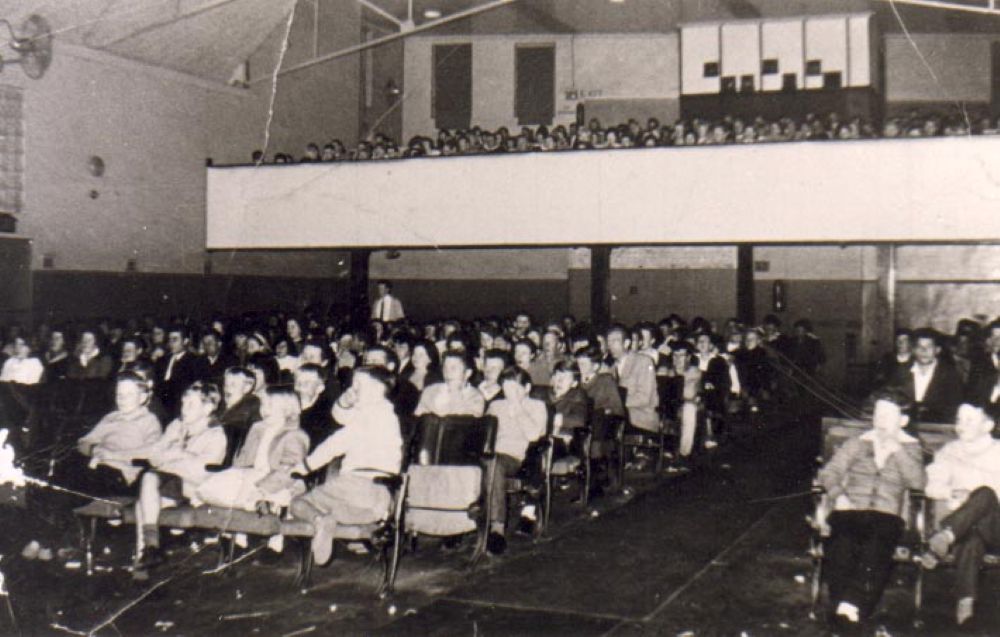
Before the Greater Union cinemas came to Macarthur Square, before the Dumaresq Street twin cinemas arrived in 1981, a picture palace was built in 1920s Campbelltown.
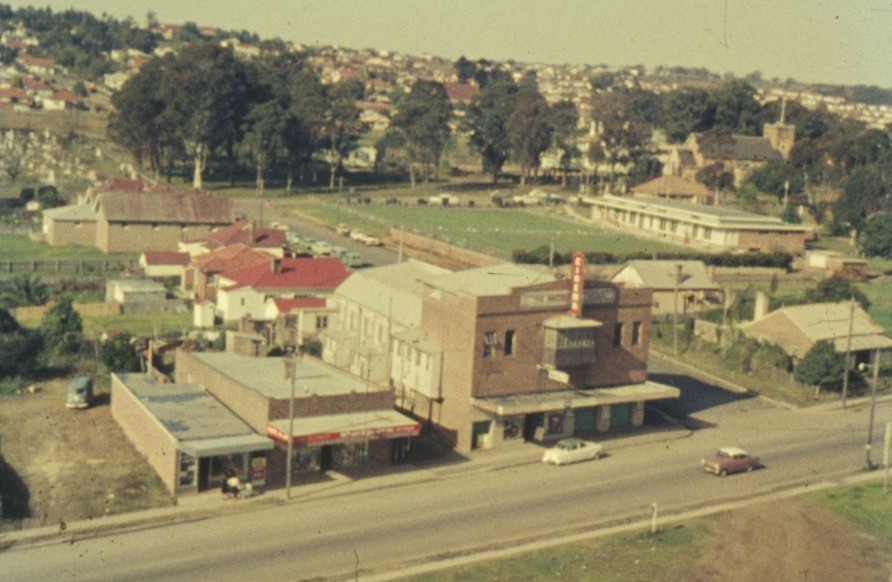
The Macquarie Cinema stood two storeys tall on the corner of Queen and Browne Streets when there were very few buildings at the northern end of Campbelltown.
It marked the first time we had a permanent “picture” theatre. Most movies shown in Campbelltown up to that point were screened at the old town hall, a make-shift affair with many limitations.
Conceived by local doctor William Mawson, brother of the explorer and architect AW Moule, the purpose-built cinema would comprise many of the sandstone blocks from the crumbling Kendall’s Mill, another property of Mawson’s.
On 28 August 1926, excited patrons made their way along dirt streets to the opening of the Macquarie Cinema where they were received by its first manager, lessee and projectionist, Ernest Holdsworth, and usherettes.
The featured movie was Zane Grey’s Western “Wild Horse Mesa”, with Douglas Fairbanks Jnr, and the cleverly chosen support feature “When the Doors Open”.
Originally seating over 450 people, 85 of those on the stage, or dress circle as they called it, an evening at the Macquarie was a welcome night out in a town sparse with entertainment, and up until the 1930s, only on Wednesdays and Saturdays.
For one shilling and nine pence, customers could get a newsreel, travelogue, two feature films like Tarzan or a Western and sometimes a cartoon such as Krazy Kat, totalling three hours of entertainment.
Doctor Mawson wasn’t entirely a silent landlord. In 1927, at the screening of Cecil B DeMille’s silent film “King of Kings”, he conducted the presbyterian choir in a rousing rendition of sacred songs.
Talkies came to Hollywood the same year, but it was years before true sound films came to Campbelltown. Prior to that, the soundtrack came separately on a record that played along with the movie.
If the disc was bumped, recalled one manager, the pickup would jump across the record throwing it out of synch. Dramas became comedies when the voices and dialogue would be accidently swapped between hero and heroine.
Always a family affair, Mrs Arthur Holdsworth was in charge of the confectionary shop.
One night in 1928, a burglary occurred. Twenty pounds worth of confectionary disappeared.
The miscreants were evidently disturbed as many boxes of chocolate remained wrapped and ready to go. The police figured on a speedy wrap-up to the case, but we do not know if any culprits were apprehended.
Possibly the most impressive additions, considering electricity had only been available to the town since 1924, was “fade away” lighting. As if that wasn’t enough, a hundred lightbulbs illuminated the Macquarie’s name, and a bright red beacon lit the apex of the building.
The New Macquarie cinema arrived in 1929, extending the front closer to the alignment of Queen Street and creating a kitchen for the Macquarie tea rooms; a wide winding staircase, floors, walls and ceiling lined with asbestos, automatic side sweeping curtains and all new Panatrope electric speaker and double turntables.
All these marvels were completed by qualified electrician Geoff Winton, whose advertised phone number was Campbelltown “1”.
The revitalised cinema was truly now a place for collective dreaming. It was presented to the public for their enjoyment on a Saturday the 26th of October, two days after the Wall Street crash.
True sound films arrived with Harry Nickless and his family when they took over in 1931.
Nickless had come from a stage background and certainly shook things up, often staging bizarre vaudevillian acts to attract customers. An ape appeared one day before the audience holding a loaded rifle.
The act called for it to shoot into a pile of fruit, but things quickly went awry when the ape bit Nickless and began waving the rifle indiscriminately at the moviegoers.
Finally, the weapon discharged … into a nearby wall. Those witnesses, and there were many, swore the ape was real and evidence of the bullet hole remained for all to see until the end of the Macquarie.
Harry Nickless rarely missed a session; such was his love of the cinema. Working there until 1954, he passed away barely months after retirement.
Mourning his passing was his widow and daughter Ida Eves. She and her husband Fred fully took over the running of the cinema. When interviewed by Campbelltown Library in 1979, Fred shared his memories as a film buyer.
“If a film was advertised in Sydney, we would always have the film the next week. We paid more … but we would rather pay for it and have the best. Knowing Campbelltown, we learnt what our patrons liked,” he said.
The Macquarie was always full in those days.
Fred continues: “We couldn’t cope with them. There would be busses running in from Macquarie Fields, Ingleburn and all around to bring the people in … a wonderful audience”.
“We would keep our eye on them, but to us they were just a family affair. They wouldn’t even know what movies were on, they would just come. They would spill out over the road, there were hardly any cars in those days,” he said.
Each year at Melbourne Cup time the race would be filmed, processed and flown to Sydney and copies sent to places like Nowra.
Each time, Fred would dutifully track down a copy: “I would drive anywhere to give my people of Campbelltown the Melbourne Cup that night”.
When Fred talked of the Macquarie, he must have been instilled with the same love of the job as his father-in-law.
“Sometimes we would have a reel to reel switch with Camden. When the reel came off I would drive back and forth to Camden. Of course people didn’t know what went on behind the scenes,” he said.
Sadly, not every screening at the Macquarie had a silver lining. The building was cold in the winter as Fred Eves acknowledges.
“But that was alright because you could cuddle up against a friend. They’d come in with rugs, water bottles and hot bricks,” he said.
In summer, to cool the building, ceiling fans were installed. That did little more than “move hot air around”. The audience entertained themselves throwing lollies up at them, which went off like “crackers” against the blades.
Attempts to stop this practice were made, patrolling the aisles.
“If we caught them, we told them to go out and stay out. That was the worst punishment you could give,” Fred recalled.
There was a blacklist. Sometimes, up to 20 people were barred for three months at a time.
“They used to try to sneak in and we would chase them up the hill,” he said.
During World War II, soldiers came from the Ingleburn army camp. Once, a soldier estimated by Fred to be nearly two metres tall, was hollering so loud no one could hear the film.
The usherettes called for assistance to get the man out. Thinking on his feet Fred approached him in the semi-darkness” “If you don’t shut up I will take you outside and belt you”.
“You will?”, came back the soldier.
Fred said, “Yes, come down the stairs.”
Running down the stairs with the soldier in pursuit, Fred had the advantage of knowing the building inside out.
“He couldn’t find me; I had gone back into the theatre. That was the only way I could get him out,” he recalled.
Sometimes, occasionally the cinema had a flea issue. But let’s not dwell on that.
Post war saw electricity strikes and on occasions, the sound of a Ford Prefect motor could be heard as a back-up generator keeping the lights and celluloid running.
The introduction of television saw a decline in theatregoers and in 1966 the Mawson estate sold the Macquarie cinema to Skatelands for around $20,000. Seats were removed, and for a time it became a roller-skating rink run by local bicycle shop owner Jack Hepher.
Sadly, the building began to decay and after being used as storage for the Downes department store across the road, the picture palace where so many of Campbelltown’s friends, families and sweethearts had come together was demolished in 1979.
- By Michael Sullivan