

Western Sydney International airport’s inaugural sustainability strategy demonstrates how Australia’s first greenfield international airport in more than 50 years has embedded sustainability into its design, significantly reducing its carbon footprint, while charting a path for a net zero airport future.
Sydney’s new 24-hour global gateway has secured two key partnerships that are pivotal to realising this vision.
CleanPeak Eenergy will support the delivery of 100 percent renewable electricity for the airport precinct.
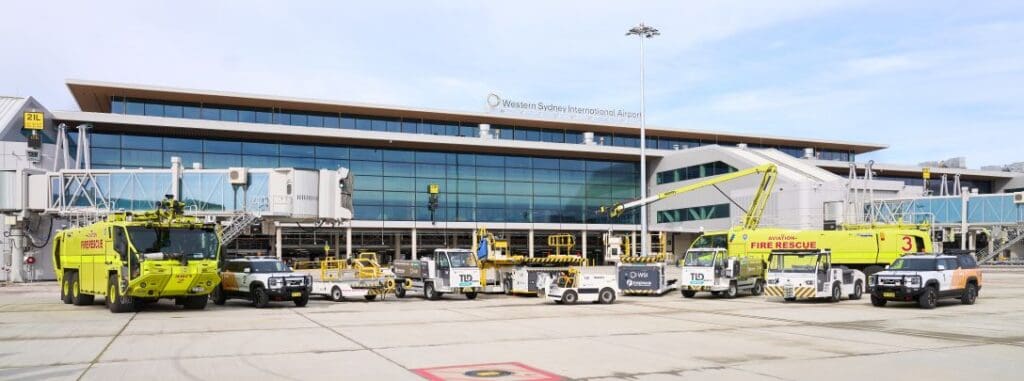
Freightquip will supply and operate an almost entirely electrified GSE (Ground Support Equipment) fleet covering the full scope of airport operations.
CEO Simon Hickey said embedding sustainability into the airport’s design and construction had set it up for success and helped ensure WSI will soon be powered by 100 percent renewable electricity – when passenger operations start – with the CleanPeak Energy collaboration integral to achieving this.
“We are delighted to be working with Australian-owned business CleanPeak to support WSI’s net zero ambitions,” he said.
“The energy system they will manage represents a landmark commitment to achieving net zero scope 1 and 2 carbon emissions for WSI, showcasing the low carbon future airports can champion as pivotal pieces of major infrastructure.”
The comprehensive energy system partnership with CleanPeak Energy will incorporate:
- Management and operation of WSI’s existing rooftop solar (that has capacity to produce 4.5MW (megawatts) of electricity, capable of powering c.40 percent of the terminal)
- Installation and management of an additional 9MW rooftop solar energy system that will gradually be built at WSI’s cargo precinct
- Installation and management of a 120MWh (megawatt hours) Battery Energy Storage System – planned for delivery in late 2027 – to provide stability, resilience, and support peak energy demand
- Management of the renewable electricity WSI purchases from the grid
- Management of the embedded network enabling the efficient distribution and optimisation of energy across WSI for airport operations and various precinct tenants
Mr Hickey said when passenger services commence later this year, WSI will become the first major Australian airport to operate an airport-wide GSE pooling program thanks to its collaboration with Freightquip, which will incorporate the highest proportion of electric GSE of any major Australian airport.
“We’ve already installed 34 electric chargers supporting sustainable ground operations,” he said.
“By combining GSE pooling with a predominantly electric fleet, WSI is modernising ground operations, improving fleet utilisation, safety and ultimately reducing the environmental impact of our operations.”



I happily remember the time when we looked at a new location for the airport. Noise was the problem at the time with aircraft passing over location in the Sydney area approaching the landing at Mascot.
I was a member of the committee that was given the development task with the first step to find a suitable location. Two of us, that was me and a colleague were given the task of finding a suitable location which needed to be able to have noise acceptable and able to be close enough to Sydney. After looking around the two of us decided on the current location with the installation of a rail link to bring passengers and cargo from Sydney to the selected site. Our choice was accepted since road, and air could provide a solution to the needs. We were congratulated on the outcome we recommended. Our dream has become reality, and it is now almost in full operation.